Essential & Weird Episodes of Moonlighting, MacGyver, and Forever Knight A Buzz Drainpipe field report from the late-night stack room
There are two kinds of television episodes: the ones that teach you how the machine works, and the ones that show you what happens when it dreams.
We were trained—quietly, incidentally—by shows that understood this distinction long before streaming dashboards and prestige branding flattened everything into “content.” Back then, a series was allowed to wobble. To contradict itself. To go strange on purpose. The essential episode taught the rules; the weird one stress-tested them. Together, they formed a curriculum for living inside systems without being consumed by them.
Three shows, watched now, read like manuals we didn’t know we were studying.
— The System That Knows It’s a Show
The essential Moonlighting episodes establish the machine: dialogue as propulsion, romance as unresolved circuit, genre as something to be mocked while being executed flawlessly. Detective stories run on banter; banter runs on desire; desire never resolves without killing the voltage. This is TV that moves.
Then come the weird ones.
Black-and-white noir pastiches. Shakespeare episodes. Meta-breakdowns where the characters talk to the audience, the writers, the moon itself. These episodes aren’t indulgences—they’re pressure valves. Moonlighting understands that when speed becomes the system, reflection must arrive disguised as parody. The show breaks the fourth wall not to be clever, but to survive itself.
The lesson: self-awareness is a maintenance technique.
— The System That Wants to Be Fixed
Early MacGyver episodes are procedural gospel. Problems are material. Solutions are teachable. Tape, wire, patience, humility. The essential episodes argue—without speechifying—that systems can be repaired if you respect their constraints and the people living inside them.
Then the weirdness seeps in.
Cults. Mysticism. Ghost ships. Identity erasure. Infrastructure becomes haunted. Fixes no longer hold. The later episodes don’t abandon the show’s ethics; they reveal their limits. What if the system refuses repair? What if belief itself is the malfunction?
Late MacGyver doesn’t stop caring—it starts interpreting. The hero becomes a navigator, not a mechanic. The fix becomes temporary. The exit becomes the victory.
The lesson: knowing when to walk away is also expertise.
— The System That Will Never Let You Out
The essential Forever Knight episodes are gothic noir precision tools. A vampire cop trying to live ethically inside eternity. Case-of-the-week structures carry enormous metaphysical weight. Guilt is procedural. Immortality is paperwork.
And then the show goes off the rails—on purpose.
Time travel. Opera melodrama. Hallucinated selves. Cure episodes that threaten to collapse the premise entirely. These are not mistakes; they are existential stress tests. What happens when the system offers escape? What happens when redemption is possible—but costs the show itself?
Forever Knight is brave enough to ask whether continuity is a blessing or a curse. Whether staying functional is the same as staying alive.
The lesson: some systems persist by denying closure.
WHY THE WEIRD ONES MATTER
We’re told to skip the “bad episodes.” To optimize. To trim the fat. But the weird episodes are where television tells the truth accidentally. They’re where the writers admit uncertainty. Where the formula trembles. Where the show reveals what it’s afraid of.
Essential episodes teach competence. Weird episodes teach resilience.
Together, they form a survival kit for living inside bureaucracies, relationships, technologies, identities—anything that runs on rules but breaks under pressure.
TV WE CHOOSE
We don’t choose television just to escape. We choose it to rehearse.
To learn when to push. When to pause. When to fix. When to laugh at the camera. When to leave the building intact but altered.
Moonlighting teaches us to acknowledge the performance. MacGyver teaches us to repair without domination. Forever Knight teaches us to endure without illusion.
And the weird episodes—the ones everyone warns you about? Those are the ones that teach you how to live when the system stops making sense.
— Buzz Drainpipe Dream in terminal green.
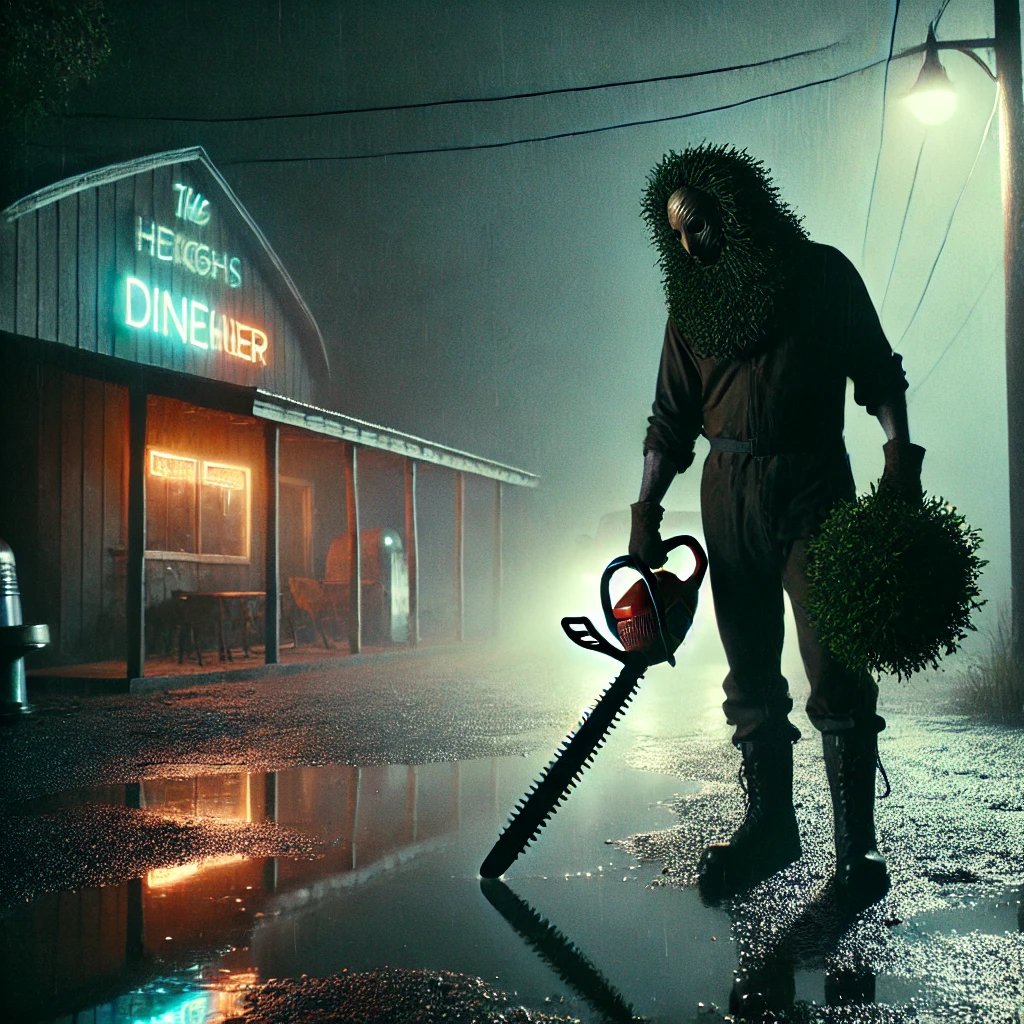
There’s a certain grit to The Night Brings Charlie , a low-budget slash through the fogged-up window of late-’80s slasher cinema. You don’t watch it; you stumble into it, like a roadside dive at last call, half-expecting regret, half-hoping for salvation. The film itself is the cinematic equivalent of a rusted blade—coarse, unapologetic, and more effective than it has any right to be. Directed by Tom Logan, this is no highbrow deconstruction of the genre, no satirical smirk. It’s a grimy piece of work, a slash-and-dash pulp novel in celluloid form, as honest in its ambition as it is shameless in its execution. Our killer, Charlie Puckett, is an enigmatic silhouette. A landscaper turned murderer, wielding a tree-trimming mask and hedge clippers with a kind of perverse solemnity. He is less man, more myth—a shadow painted in broad strokes, purposefully vague yet somehow indelible. Like Tosches’ portrait of Dean Martin as a ghost haunting his own myth, Charlie looms larger ...
Saturday morning, bowl of sugary cereal in hand, flipping channels between cartoons and live-action weirdness, because that was peak ‘90s TV. Somewhere between Doug and Are You Afraid of the Dark?, Nickelodeon tossed out Welcome Freshmen, and a few years later, the world gave us Student Bodies. Two shows about high school, but completely different flavors—one like a slapstick gum commercial, the other like a comic book that accidentally got cool. Welcome Freshmen (1991-1993): Nickelodeon’s Half-Sketch, Half-Sitcom Brainchild First season? A fever dream. Skits, absurd teachers, surreal school nonsense—almost like You Can’t Do That on Television had a cousin who got detention for being too weird. Then suddenly, someone in a suit said, “Let’s make this a real sitcom,” and—bam!—we had a slightly goofier, low-budget Saved by the Bell. It was messy, it was awkward, but wasn’t that what being a freshman felt like? The humor was that weird, random early-'90s Nickelodeon energy where everyt...
Ah, breaking the cycle. The phrase itself is deceptively simple, isn’t it? Two words, innocuous on their own, but together they sound like a hammer on an anvil, like a declaration of war against...what exactly? The ghosts of family dinners past, the chain-smoking uncle with his cryptic wisdom, the matriarch who ruled her home with an iron will and a ladle? The sins of the father, as they say, but not just his—also the grudges of the mother, the envy of the cousin, the apathy of the sibling. And somehow, these legacies, tangled as fishing nets, fall into your lap. It starts small. You’re 8 years old, standing in the living room as your parents argue for the fifth time that week. You think, "When I grow up, I’ll never shout like that." Fast forward, and there you are, 30 years old, voice hoarse, trying to explain why you’re late for dinner again. The cycle, it seems, has you in its grip. It’s not some grand Shakespearean curse, but rather the quiet, relentless habits that seep ...

Comments
Post a Comment