Posts

Showing posts from February, 2025

The Midnight Alchemy of Soul: How Stax, Volt, and Motown Musicians Turned Jazz Club Sparks into Immortal Grooves

Image
There’s something almost mystical about the way a groove is born. It’s not a thing of cold precision or highbrow calculation—it’s a spirit conjured in smoke-lit rooms, where musicians play like they’re chasing ghosts, catching whispers of melodies in the ether and shaping them into something solid, something that could make a whole generation move. The great house bands of Stax, Volt, and Motown—Booker T. & the M.G.’s, The Funk Brothers, the Bar-Kays—were more than just session players. They were high priests of rhythm, pulling magic from thin air.   It would start the night before a session, long after the world’s squares had turned in for sleep. The clubs were where the real work happened. Detroit’s Blue Bird Inn, Memphis’ Plantation Inn, some hole-in-the-wall joint down in Muscle Shoals—this was the true testing ground. The M.G.'s might slide into a bluesy vamp, Al Jackson Jr. setting up a backbeat so thick you could lay your troubles on it. James Jamerson, ...

Underrated Rockers: Sherbet / The Sherbs – The Band That Couldn’t Catch a Break

Image
Some bands just get lost in the shuffle. Bad timing, bad marketing, bad luck—it doesn’t matter how good you are if the stars don’t align. Case in point: Sherbet, later rechristened The Sherbs, one of Australia’s finest power-pop and rock outfits of the ‘70s and early ‘80s. If the universe had been playing fair, these guys would have been breathing the same rarefied air as Cheap Trick or even Toto. Instead, they’re a footnote, unfairly buried beneath the avalanche of forgotten AM radio gold.   Formed in Sydney in the late ‘60s, Sherbet had everything a band needed to succeed: killer hooks, tight musicianship, and a frontman in Daryl Braithwaite who could belt out an anthem with the best of them. They weren’t just another sunshine-and-innocence pop act; they were craftsmen, sculpting melody into something bigger than the sum of its parts. Listen to “Howzat” (their lone international hit in 1976), and you’ll hear a song that should have dominated jukeboxes worldwide—a sleek, funk...

*Flickering Phantoms: The Forgotten Signals of Late-Night Television**

Image
Television is a graveyard, a place where forgotten ghosts flicker between static-laden transmissions, whispering of once-bright futures snuffed out by network executives with the attention span of a goldfish on amphetamines. The real tragedy? Some of these ghosts deserved better.   Let’s dig up a few of them.   --- #### **Night Stand (1995-1999) – The Tabloid Trainwreck That Knew Exactly What It Was**   Before *The Daily Show* sharpened its knives on political satire, before *Maury* turned paternity tests into bloodsport, there was *Night Stand*—a savage, surrealist parody of trashy tabloid talk shows. Hosted by Timothy Stack as the gloriously unhinged Dick Dietrick, the show was a deadpan send-up of *Jerry Springer*-style excess, embracing the absurdity of its real-world counterparts with a commitment that bordered on sociopathic.   Every episode spiraled into sheer chaos—Dietrick’s self-absorbed monologues, guests whose p...

**The Static Between Forgotten Signals**

Image
The internet is supposed to remember everything. The great, humming archive of human folly and brilliance, stored in server farms humming with the ghosts of lost connections. But time erodes even digital relics. TV shows flicker in and out of existence, slipping between algorithmic cracks like lost souls in a haunted broadcast.   Look at this list—bones of dead television, spectral fragments of a medium that once thrived on cheap sets and half-mad ambition. **Bone Chillers**, a ‘90s horror anthology that tried to slip some Lovecraftian weirdness past the censors while still selling plastic fangs at Halloween. **Lexx**, a gonzo space opera with the energy of a late-night fever dream, where the universe was hostile, flesh was disposable, and nobody was the hero.   **Shoestring**—a detective show with the quiet, British melancholy of a rainy afternoon, where solving mysteries felt less like justice and more like making sense of the inexplicable. **Something ...

*The Unexpected Magic of *Dreams Come True* (1984): A Whimsical Tale Hidden in the VHS Sleaze Era**

Image
There’s something strangely enchanting about *Dreams Come True* (1984), a little-known oddity that exists in the twilight zone between softcore fantasy and the kind of dreamy, low-budget charm that the VHS era often buried beneath layers of sleaze. At first glance, it might seem like just another late-night rental meant to capitalize on the erotic fantasy boom of the early ‘80s. But if you look closer, you’ll find a whimsical, almost innocent undercurrent that sets it apart from the more cynical fare of its time.   The film follows a young woman who discovers that her dreams have the power to shape reality—leading to a surreal journey filled with wish fulfillment, sensuality, and a touch of fairy tale logic. While it leans into its erotic elements, there’s a curious sweetness to it, a sense of wonder that feels more *Labyrinth* than *Emmanuelle*. The dream sequences are drenched in soft-focus cinematography, pastel lighting, and an ethereal synth-heavy score that makes everyth...

“CAMP BLOOD” (1999) & “CAMP BLOOD 2” (2000): THE SLASHER CINEMA OF PURE ID

Image
By Lou Toad Let’s get this out of the way: Camp Blood (1999) and its direct-to-video sequel Camp Blood 2 (2000) are, by any metric resembling “quality,” irredeemably bad movies. The acting is bad in the way that people who have never acted think acting should be. The budget—barely cresting the triple digits—ensures that everything from lighting to sound design resembles the most expensive home video you and your friends never made. The plot is a Mad Libs version of Friday the 13th , which itself was a Mad Libs version of Halloween , and it all plays out with the self-serious commitment of a high school drama club doing a “mature” play about drug addiction. And yet. In 1999, I was 13. The same year The Blair Witch Project (another no-budget horror film, albeit one that did things like invent a genre ) tricked half of America into thinking it was real, I was in my friend’s backyard with a Hi8 camcorder, two cheap masks from Spencer’s, and a script written on the back of my Algebra...

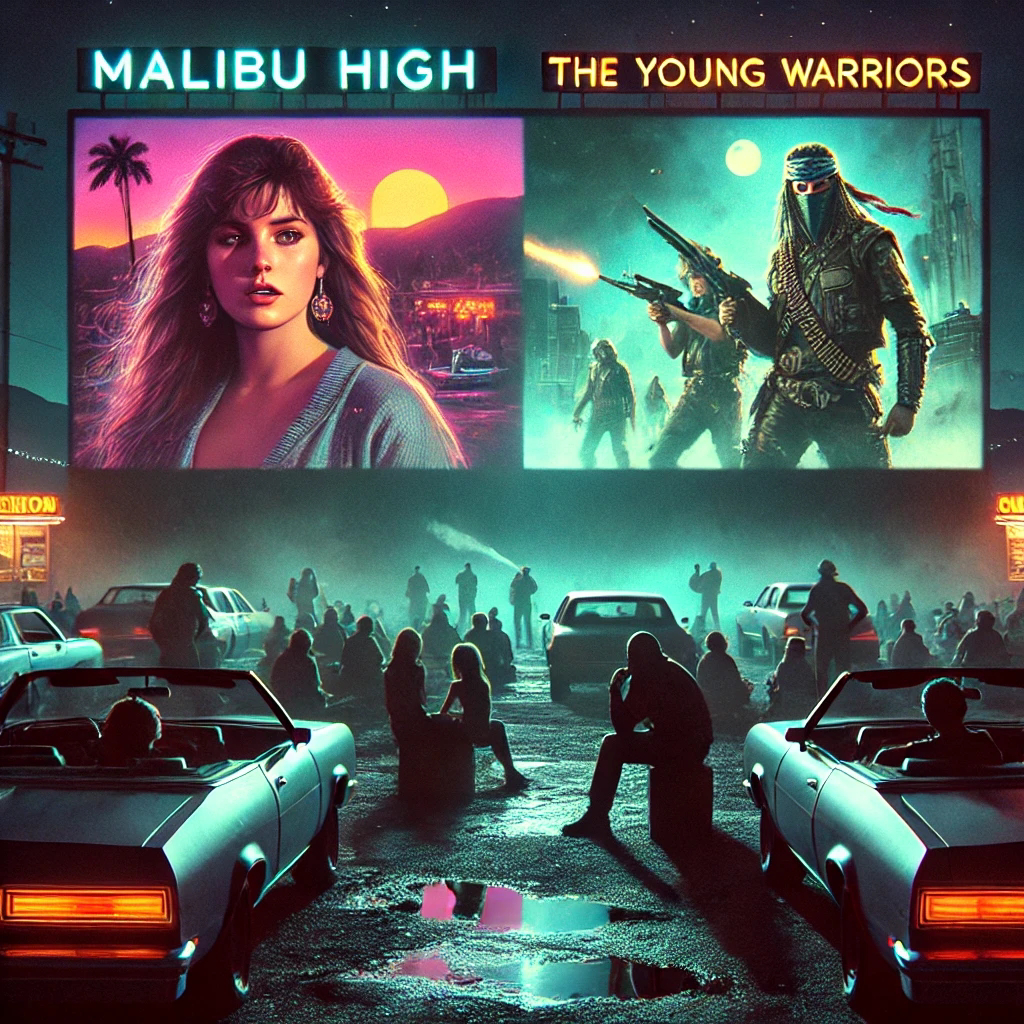
The Secret Subversion of *Malibu High* and *The Young Warriors***

Image
### **I. The Sleaze Mirage of Malibu**   It’s the late ’70s. Gas is expensive, the American psyche is bruised from Vietnam, and cinema is caught in a twilight zone between the grindhouse gutter and the blockbuster dawn. Enter *Malibu High* (1979), a cheap and dirty film that markets itself as a teen sex comedy but quickly morphs into a nihilistic crime saga where high school is just a launchpad for prostitution, murder, and existential doom.  This is not *Porky’s*, not *Fast Times at Ridgemont High*, but something far uglier—like if *Carrie* had no supernatural powers and instead just said, “Screw it, I’ll become a hitwoman.” Kim, our “heroine” (and I use that term loosely), starts as a jilted high school outcast and ends as a dead girl on a beach, her life swallowed by her own descent into crime. There is no redemption. No happy ending. Only the void.   Was this just exploitation at its purest? Or was there something more? A quiet, unspoken subversi...

"Your Mad Retahded, Kid”: Growing Up Smart in 90s Inner-City Boston

Image
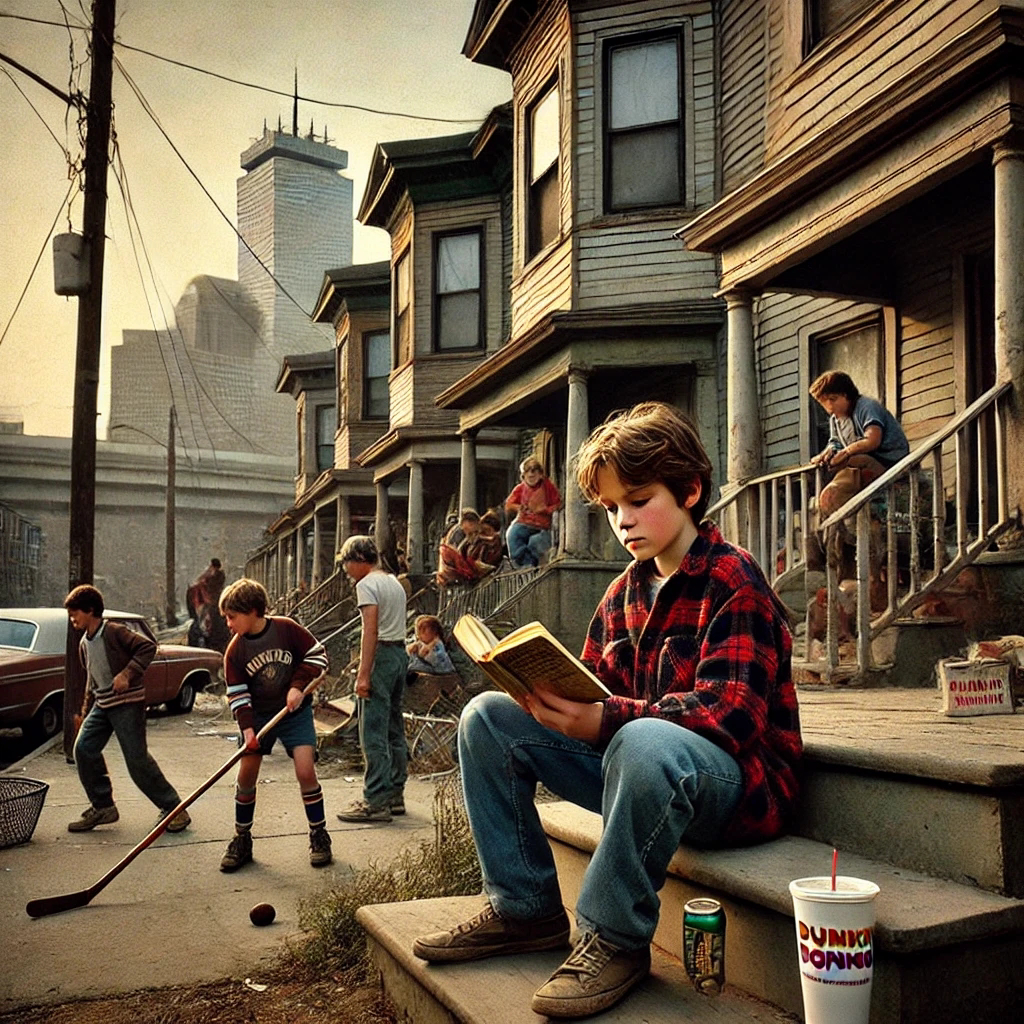
By Lou Toad There was always something vaguely suspect about being the kid with his nose in a book in 1990s inner-city Boston. Especially in Eastie, where I grew up—triple-deckers crammed together like old teeth, the airport skyline flickering in the windows, and the low murmur of NESN sports talk from every open screen door. Intelligence, or at least the performance of it, was met with suspicion, sometimes outright hostility. You could be smart, sure. You just couldn’t be a **smarty-pants.**   I got called “mad retahded” more times than I can count, which in the upside-down logic of the neighborhood meant I was too smart for my own good. You start spouting off about something—history, science, some book nobody else was reading—and suddenly you’re “some kinda fuckin’ genius now, huh?” The code of the streets (or at least the block) dictated that if you weren’t talking about the Sox, the Pats, or what some wiseass down the bar at Jeveli’s got up to last weekend, you...

Tune In Tuesday: The Devonsville Terror (1983) – A Folk Horror Freakout with That Vinegar Syndrome Glow

Image
Stack up those Blu-rays, flip off the lights, and let that warm, grainy magic roll—because *The Devonsville Terror* is the kind of late-night shocker that just *hits different* when you're knee-deep in a stack of Vinegar Syndrome discs. You know the deal: slipcase fresh, remastered menace, and the kind of deep-cut unearthed weirdness that makes you wonder how this one slipped through the cracks of your horror consciousness until now.   On the surface, Ulli Lommel’s *The Devonsville Terror* is prime folk horror territory—Puritanical paranoia, past sins festering under the surface of a small New England town, and a supernatural reckoning centuries in the making. But this ain't some cozy autumnal *Wicker Man* riff. It’s got that early-'80s video-store murk, where dreamy soft-focus atmosphere crashes headfirst into rubbery gore and batshit tonal shifts. Lommel, best known for his *Boogeyman* schlock, gets *real* weird here, mixing small-town misogyny with supernatur...

All about that Showtime prestige TV

Image
Twin Peaks: The Return and Penny Dreadful—two eldritch incantations whispered through the static of television’s golden age, each a spectral invocation of mystery, dread, and the unrelenting human quest for meaning in the shadows of existence.   David Lynch’s Twin Peaks, a symphony of dream logic and uncanny dissonance, unfurls like an ancient riddle carved into the firmament of our subconscious. It is a vision of time as a Möbius strip, a coffee-black abyss in which the seeker, ever intrepid, searches for the fire behind the velvet curtain. It dares to ask: can the self be retrieved once scattered across the infinite planes of dream and reality? Or does the search itself obliterate the seeker?   Meanwhile, Penny Dreadful exults in the gothic sublime, a feast of poetry and horror stitched together from the night terrors of the 19th century. Its creatures—tragic, yearning, monstrous—move through the sepulchral corridors of fate, each bound by t...

Rediscovering *Disturbing Behavior*: The Misunderstood Classic of Late-90s Horror

Image
By the late ‘90s, the post-*Scream* horror boom had reached full tilt, and teen slashers were the genre’s reigning champions. But lurking beneath the surface of that trend was *Disturbing Behavior* (1998), a film dismissed in its day as yet another pale imitation. Time, however, has been unusually kind to this eerie slice of paranoia, and with a fresh eye—especially in light of the now-legendary lost *director’s cut*—it stands revealed as something far more sinister and subversive than audiences were prepared for.   Directed by David Nutter (a *X-Files* alumnus with a knack for eerie Americana), *Disturbing Behavior* plays like *The Stepford Wives* got hijacked by a caffeine-addled *Goosebumps* ghostwriter in the middle of a nervous breakdown. On the surface, it’s a standard “new kid in town” setup: Steve (James Marsden) moves to the perpetually overcast island town of Cradle Bay, where the high school’s ruling class—the eerily clean-cut “Blue Ribbons”—seem more ma...

Virtual Album Haul

Image

the easy listening prog rock paradox

Image
Alright, LISTEN UP, you golden-eared, soft-focus dreamers, you seekers of groove both slick and cerebral! You, wandering in the valley between the crystalline perfection of pop and the labyrinthine wizardry of progressive rock, wondering: **How did they do it? How did they make it so smooth yet so damn complicated?**   I’ll tell you HOW. I’ll tell you WHY.   Because in the late '70s, a secret brotherhood emerged, clad not in leather and denim, no—no, my friend! These were the **session-sorcerers, the yacht-prog shamans, the technicians of feeling.** They wielded smoothness like a scalpel, cutting deep without spilling a drop.   ***Toto.*** Kenny Loggins. Pages. ***Gino Freakin’ Vannelli.***   They stood at the impossible crossroads where Steely Dan meets Mahavishnu, where Michael McDonald harmonizes with a Moog bassline so slick it hydroplanes into oblivion. They were NOT your average rock gods, no—they were *meticulous.* Their fingers...

Fear and Loathing in the Valley: A Savage Journey into Encino Man and the Quiet Cool of Brendan Fraser

Image
It was a warm, sun-blasted afternoon in the San Fernando Valley, and the air smelled of chlorine, desperation, and the faint promise of something absurdly prehistoric. *Encino Man*, that legendary 1992 cinematic fever dream, is a film that defies logic, coherence, and perhaps even good taste. But none of that matters. What matters is the presence of Brendan Fraser—wide-eyed, slack-jawed, a resurrected Cro-Magnon surfing the chaotic neon hellscape of early ‘90s suburbia.   Fraser, a man who would go on to carve out a career in everything from Mummy-hunting to full-throttle existential despair, was in his purest, most chaotic form here: all grunts, primal energy, and a physicality that bordered on slapstick divinity. His character, Link, is a thawed-out caveman, a fish-out-of-water in a world of MTV, Pauly Shore, and inexplicable teenage angst. But beneath the absurdity lurks something almost poetic—an outsider, gleefully ignorant of the petty hierarchies of high sch...

The Eternal Cool of Ric Ocasek and the Underrated Brilliance of Beatitude

Image
Ric Ocasek wasn’t just cool—he was *cool in italics*, cool without trying, the kind of cool that can’t be faked. He looked like an alien who crash-landed on CBGB’s doorstep, absorbed all the neon sleaze, new wave sheen, and punk irreverence, and spat it back out as something completely his own. He wasn’t a rock star in the classic sense—no grandstanding, no pyrotechnic solos—but he had *presence*. A looming, spectral figure in shades, standing at the crossroads of Buddy Holly and Blade Runner, crooning like a machine that found out about love from overheard conversations and late-night radio.    And *Beatitude* (1982) is *that* Ric Ocasek distilled. His first solo album, dropped while The Cars were still hot as a freshly waxed hood, is what happens when the robot takes a step out of the showroom and into the back alley. It’s colder, weirder, more stripped-down, and, at times, darker than his band’s glossy radio anthems. But it’s also a total *Ocasek* record—sharp, ...

Of Cabbages and Kings – Chad & Jeremy’s Psychedelic Left Turn

Image
By the mid-‘60s, Chad Stuart and Jeremy Clyde had already carved out their niche as purveyors of gentle, harmony-driven folk-pop. They were the thinking person’s duo, offering up sophisticated melodies wrapped in a veneer of British cool. But *Of Cabbages and Kings* (1967) was something else entirely—a bold, orchestral, psychedelic opus that found them stretching the boundaries of their sound in ways that few expected.   If the title nods to Lewis Carroll, the music itself is a full immersion into the topsy-turvy headspace of the late ‘60s, where folk, baroque pop, and avant-garde experimentation collided. It’s an album that sits comfortably next to the likes of *Sgt. Pepper* or *Days of Future Passed* in ambition, even if it never reached those commercial heights.   ### **A Kaleidoscope of Sound**   What makes *Of Cabbages and Kings* stand out is its sheer theatricality. The production—helmed by Gary Usher, a man known for his work with The Byr...

The Night Brings Charlie: An Analysis and Review

Image
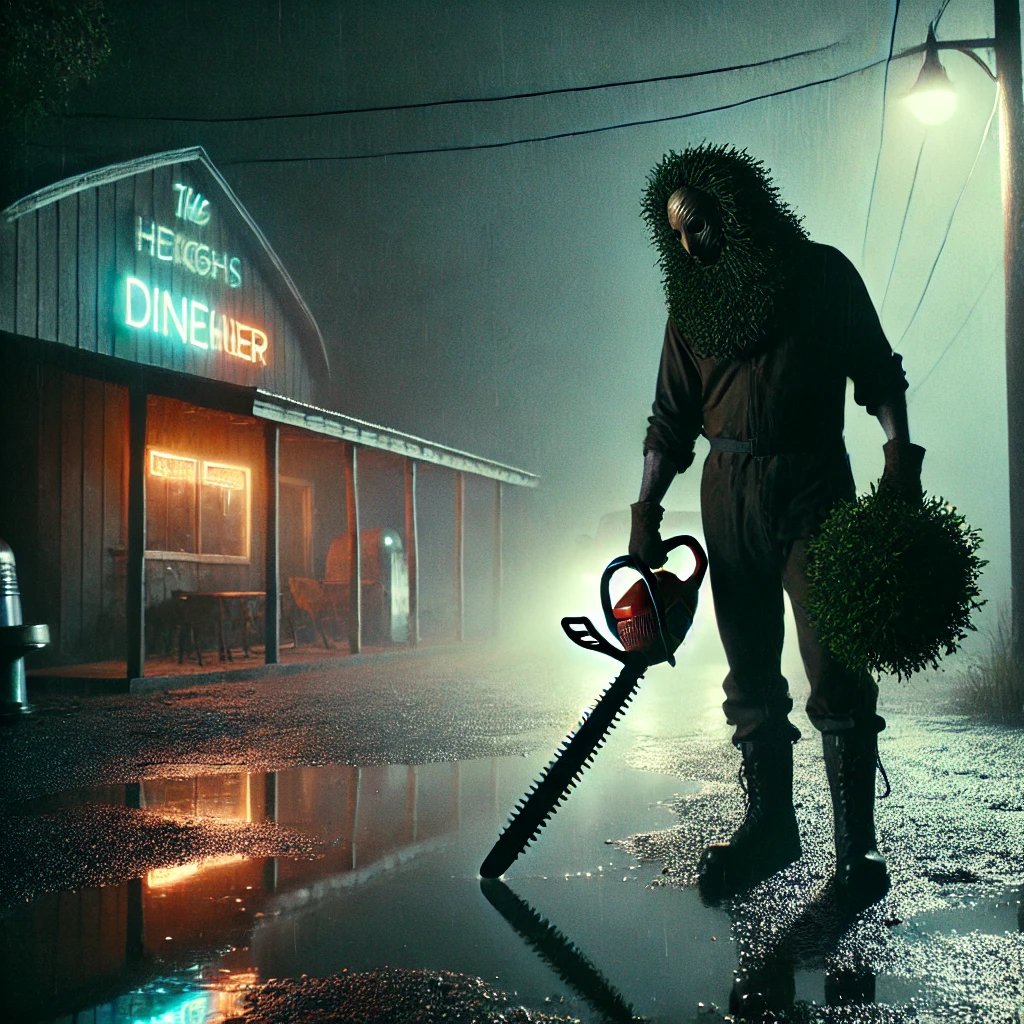
There’s a certain grit to The Night Brings Charlie , a low-budget slash through the fogged-up window of late-’80s slasher cinema. You don’t watch it; you stumble into it, like a roadside dive at last call, half-expecting regret, half-hoping for salvation. The film itself is the cinematic equivalent of a rusted blade—coarse, unapologetic, and more effective than it has any right to be. Directed by Tom Logan, this is no highbrow deconstruction of the genre, no satirical smirk. It’s a grimy piece of work, a slash-and-dash pulp novel in celluloid form, as honest in its ambition as it is shameless in its execution. Our killer, Charlie Puckett, is an enigmatic silhouette. A landscaper turned murderer, wielding a tree-trimming mask and hedge clippers with a kind of perverse solemnity. He is less man, more myth—a shadow painted in broad strokes, purposefully vague yet somehow indelible. Like Tosches’ portrait of Dean Martin as a ghost haunting his own myth, Charlie looms larger ...

A Glowing Tribute to Tag: The Assassination Game

Image
There’s something hauntingly prophetic about Tag: The Assassination Game , a film that slithered out of the Reagan-era mire in 1982 with all the cool detachment of a leather-clad nihilist. Directed by Nick Castle—better known to trivia buffs as the man behind Michael Myers’ mask in Halloween —this low-budget thriller somehow fuses the pop-culture paranoia of its time with a razor-sharp edge that cuts deeper than its unassuming premise might suggest. On the surface, Tag plays out like a dorm room fever dream: a campus-wide game of "Assassin" turns lethal when an unhinged participant decides to up the stakes by swapping suction-cup darts for the real thing. It’s a concept so deliciously absurd it could’ve derailed into self-parody, yet Castle and company steer the chaos into something more—an existential noir wrapped in the trappings of a college B-movie. Linda Hamilton, in her pre- Terminator days, radiates star power as Susan, the quintessential '80s hero...

rough notes for the rabid intellectual

Image
*The Rabid Intellectual**   **Chapter 1: Ethertown’s Machine**   By day, Vincent Carroway was just another cog in Ethertown’s relentless financial district. He worked tirelessly as a business development representative, drowning in spreadsheets, cold calls, and performance reviews. The glass towers of Ethertown loomed around him, casting long shadows that mirrored the empty, grinding hum of capitalism. To his colleagues, he was efficient, reliable, and focused—traits that earned polite nods in the break room but little else.   But Vincent’s real life began when the sun dipped below the skyline and the city’s veneer of productivity gave way to its raw, pulsating underbelly.   As twilight fell, Vincent would discard his suit jacket and tie, leaving them crumpled in the corner of his tiny apartment. He swapped his polished shoes for scuffed boots and his business demeanor for the sharp edge of a rabid storyteller. Armed with a battered leather satche...

The Wilds of Worcester and the Whats

Image
The year was 1837, and the town of Worcester was still a fledgling settlement clinging to the edge of Massachusetts’ wilds. Beyond its modest boundaries lay a tangled wilderness of gnarled oaks and dark, sprawling marshes, known to the locals as the Black Fen. Few dared venture there, for whispers spoke of things—shapeless, nameless beings—that fed not on flesh, but on something deeper, something vital. These whispers called them the "Whats." Gideon Parrish, a man of stout build and sharper wit, was a surveyor by trade, charged with charting the Fen for proposed roads and settlements. He’d heard the tales, of course: how entire families had vanished, their cabins found intact but their hearths cold and their beds undisturbed. Gideon dismissed them as the fever dreams of idle minds. Yet as he stood on the edge of the Black Fen, the air heavy with the scent of rot and decay, unease crept into his heart. The first day in the Fen was uneventful. Gideon sketched the tw...

The Frosted Path to Worcester

Image
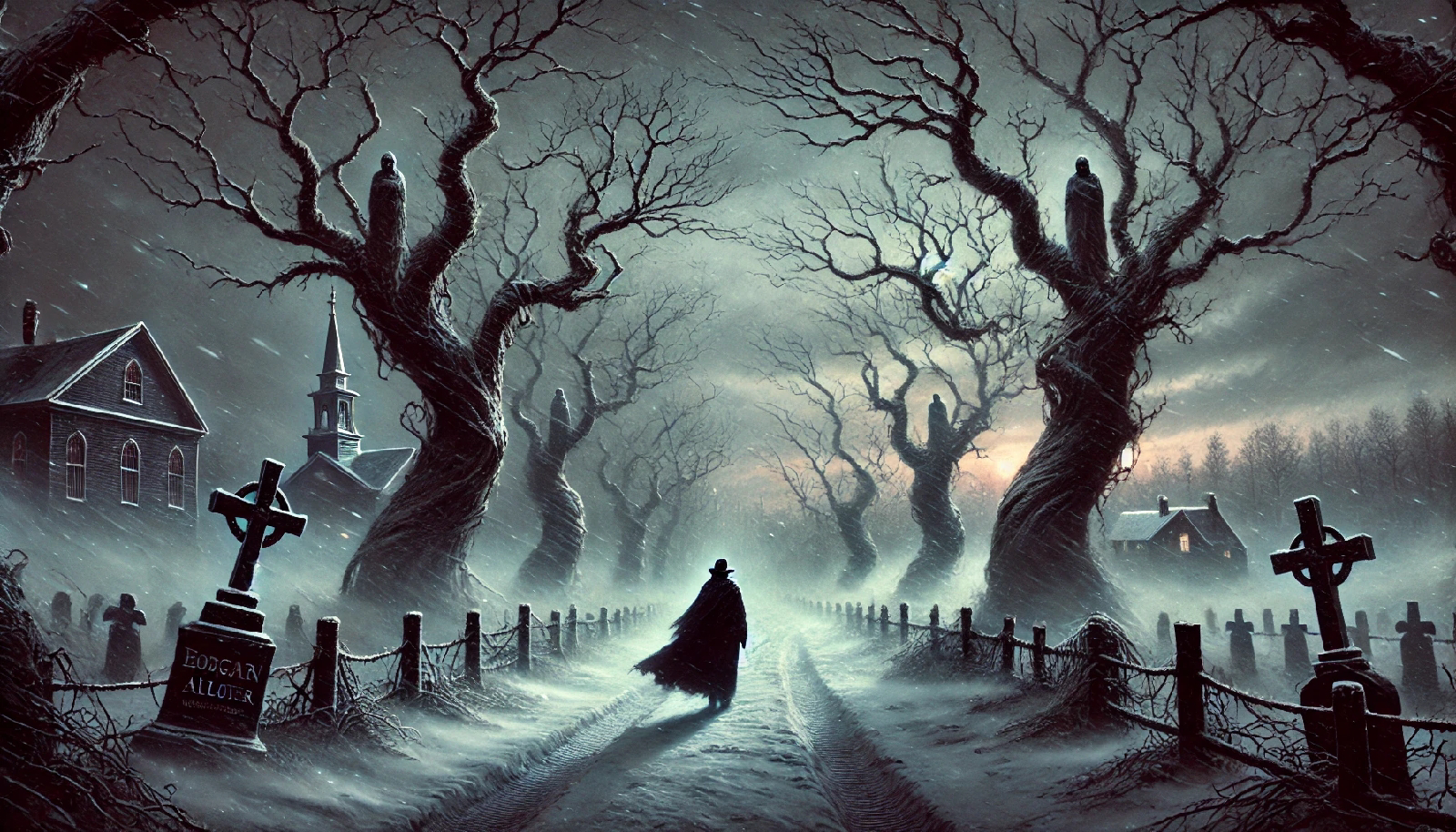
Through the shadows cold and dreary,   Where the wind wails wild and weary,   I embarked from Boston's harbor,   Under skies as dark as lore.   Onward through the snow-bound valley,   Where no sun would dare to rally,   Lay the road—a solemn whisper   Stretching far to Worcester's door.   The trees, like phantoms, looming, swaying,   In the biting gusts were praying,   And the frost upon the branches   Gleamed like spectral, haunted spore.   Each step deeper, darker, colder,   Winds grew fierce, the night grew bolder,   'Til my breath became an echo,   Bound to haunt the frozen floor.   Yet, through all this grim desolation,   Rose a dreadful fascination—   What, I thought, does winter mutter   In this land of ancient lore?   In its hush, a voice did tremble,   Soft ye...

"Bart Simpson: Underachiever and Proud of It - A Postmodern Manifesto of Rejection and Freedom"

In the chaotic universe of The Simpsons , few characters embody the essence of postmodern rebellion like Bart Simpson. While Homer and Marge's traditional familial roles offer a semblance of order, Bart shatters the confines of conformity with a deeply postmodern ethos: underachievement is not a flaw, but a declaration of freedom. In the postmodern world, where truth is often fragmented and power structures are increasingly questioned, Bart’s self-proclaimed status as an underachiever becomes an act of defiance. He’s not bound by societal expectations, academic success, or even the pressure of traditional masculinity. Instead, Bart occupies a space where failure becomes his weapon, and the refusal to adhere to a singular path is his triumph. Rejection of Modernism's Grand Narratives Postmodernism is marked by its skepticism toward grand, overarching narratives—those tales of progress, success, and social ascension that modernism so fervently supported. Bart’s rejection of s...