Posts

Showing posts from March, 2025

Jean Genies

Image
Jean Cocteau: A Life in Art Jean Cocteau (1889–1963) was a French writer, poet, filmmaker, playwright, designer, and artist whose work spanned multiple disciplines and shaped modern artistic movements. A central figure in 20th-century avant-garde culture, Cocteau’s creations blurred the lines between literature, visual art, theater, and cinema, making him one of the most influential artists of his time. Early Life and Influences Jean Maurice Eugène Clément Cocteau was born on July 5, 1889, in Maisons-Laffitte, France, into a wealthy bourgeois family. His father, Georges Cocteau, was a lawyer and amateur artist who died by suicide when Jean was only nine years old. This loss had a profound impact on him, and he later explored themes of death and the subconscious in his works. Raised by his mother, Eugénie Lecomte, Cocteau displayed an early aptitude for literature and the arts. By his teenage years, Cocteau had immersed himself in the bohemian circles of Paris, frequenting salons an...

"Through the Looking Glass: Cocteau’s Orphic Trilogy Decanted"

The Orphic Trilogy by Jean Cocteau— The Blood of a Poet (1930), Orpheus (1950), and Testament of Orpheus (1960)—is not just cinema but a hallucinatory descent into the mirror-labyrinth of the soul. These films beg to be watched through the bottom of a red wine glass, where reality distorts into something richer, darker, more poetic. They’re soaked in myth, shimmering with avant-garde pretension, but it’s the kind of pretension you want to get lost in, like wandering into a party of surrealists and philosophers you barely understand but feel utterly enchanted by. Take The Blood of a Poet , a film so abstract it practically dares you to scoff, but instead, you find yourself drawn into its fever dream of flying statues, snowball deaths, and corridors of voyeurism. It's less a narrative and more a séance, and by your second glass of Syrah, you’re no longer questioning its cryptic imagery. You’re just floating in it. Then there’s Orpheus , perhaps the most intoxicating of the trilo...

Wim Wenders’ Road Trilogy: A Punch-Drunk Stumble Through Existential Asphalt

It starts with a map, doesn’t it? A fold-out, creased-to-death map that smells faintly of coffee rings and dashed hopes. Wim Wenders’ Road Trilogy — Alice in the Cities (1974), Wrong Move (1975), and Kings of the Road (1976) — is less a celebration of the open road than a confession to it. These are films that rub shoulders with the ghosts of Jack Kerouac and Werner Herzog, though in Wenders’ hands, the road doesn’t sing. It mutters, stumbles, and occasionally spits in your face. Alice in the Cities : A Polaroid in Purgatory The trilogy kicks off with Alice in the Cities, a film that feels like waking up hungover on a stranger’s couch, clutching someone else’s memories. Philip Winter, the writer-turned-wandering-Polaroid-snapper, is a man who’s misplaced himself. He picks up a camera, as if snapping pictures of motels and gas stations will stitch him back together. Enter Alice, a precocious child dumped into his reluctant care. The road they travel isn’t some mythical artery of...

The Masked Ennui of Mortimer Graye

Mortimer Graye had once been the face of justice—or rather, the mask. In the 1940s, he’d soared across silver screens as THATMAN, the shadowy avenger of crime in a series of B-grade serials that promised twelve cliffhangers and delivered precisely twelve resolutions, all involving Mortimer's square jaw, a cascade of punches, and a signature line: “Justice always bats last!” But now it was the mid-1960s, and Mortimer was a man adrift. At sixty-two, his once-chiseled features had softened into a face more suited to selling cigars than delivering justice. Hollywood had moved on, leaving him to pick at the remnants of a once-bright career. His mornings began with cold coffee and silent arguments with his reflection. His evenings ended with too many glasses of sherry and the faint hum of static from his forgotten television set. Then came the call from Heyboy Mansion. A Resurrection of Irony Heyboy Mansion had become a haven for the cool crowd—a place where irony and self-awareness...

Record Review

The Wanderers – Only Lovers Left Alive (1981) is a record that feels like the electric ghost of rockers past and future, a haunted transmission from a time when punk, glam, and dystopian paranoia clashed in neon-lit alleyways. Fronted by Stiv Bators—already a legend from his time in the Dead Boys—The Wanderers took a detour from the raw nihilism of punk and dove headfirst into a synth-laced, sci-fi vision of rock ‘n’ roll rebellion. Inspired by Dave Wallis' apocalyptic novel of the same name, the album pulses with the energy of a world on the brink, fusing the sneering attitude of ‘77 punk with the grand, cinematic scope of dystopian rock operas. Tracks like No Dreams and It’s All the Same channel the desperate urgency of early punk while layering on ghostly synths and echoed vocals, as if beamed in from a lost radio station in a crumbling metropolis. Ready to Snap is all jagged edges and paranoid energy, while Can’t Take You Anymore struts with a glam rock swagger that reca...

The High Arts: A Review of Paterson & Saltburn

Image
Paterson (2016) – The Poetry of the Mundane Jim Jarmusch’s Paterson unfolds like a haiku—a meditation on the quiet rhythms of life, carefully arranged yet deceptively simple. Adam Driver plays Paterson, a bus driver in Paterson, New Jersey, who also happens to be a poet. His days are a ritualistic blend of morning kisses, overheard conversations, long walks with his recalcitrant English bulldog, and scribbling poems in a notebook. There’s a wry amusement in watching a man so utterly unfazed by modern chaos. His wife, Laura (Golshifteh Farahani), a woman of boundless ambition and monochrome enthusiasm, serves as an unintentional comic counterpoint. While she dreams in grandiose black-and-white patterns—cupcake empires, country music stardom—Paterson remains anchored in small, perfect observations. Jarmusch, ever the connoisseur of deadpan existentialism, offers no dramatic crescendos, no fiery altercations, no grand revelations. The most harrowing moment comes when Pat...

Sunday Night Trash Review: I Bought a Vampire Motorcycle (1990)

Image
Sometimes, cinema isn’t about art or profound storytelling. Sometimes, it’s about letting loose and reveling in absurdity. I Bought a Vampire Motorcycle (1990) is exactly that—a gloriously bonkers slice of British B-movie trash that dares to ask: What if your motorcycle was possessed by demonic forces and developed a thirst for blood? Plot The story follows Noddy, a down-on-his-luck biker, who unwittingly purchases a motorbike imbued with the spirit of a satanic cult victim. Cue ridiculous carnage as the bike gains sentience, craves human flesh, and wreaks havoc in the most ludicrous ways possible. The Wild This film is a fever dream of gratuitous gore, surreal comedy, and over-the-top performances. The practical effects—while undeniably cheesy—are creatively grotesque, from the bike’s demonic transformations to its bloodthirsty rampages. A standout scene features a motorized showdown that’s both hysterically absurd and surprisingly tense. The dialogue is riddled wit...

Rediscovering Toto’s Turn Back: An Underrated Gem

Image
Toto's third album, Turn Back (1981), often sits in the shadow of their mega-hits like Toto IV and Africa , but it deserves a reassessment. Marked by its distinct blend of rock ambition and melodic craftsmanship, the album is an exhilarating ride that reflects the band's musical virtuosity while exploring a harder-edged sound compared to their earlier releases. Opening with the explosive "Gift with a Golden Gun," the album wastes no time showcasing Toto's instrumental prowess and knack for tight arrangements. The track brims with energy, signaling the band's desire to embrace a more guitar-driven approach. Throughout the record, Steve Lukather’s blistering guitar work stands front and center, bolstered by Jeff Porcaro's impeccable drumming and David Paich's textured keyboard layers. Tracks like "English Eyes" and "I Think I Could Stand You Forever" highlight the band's underrated lyrical depth, weaving themes of...

Sunday Horror Afternoon Review: Spellcaster (1992)

Image
If Spellcaster (1992) feels like a fever dream of ‘80s MTV culture and classic haunted-house horror, that’s because it is. A film born from a love of campy excess, low-budget charm, and a sprinkle of supernatural mayhem, this oddball treasure revels in its own ridiculousness while delivering enough weirdness to make it perfect for a lazy Sunday scare session. The setup is wonderfully straightforward: a group of contest winners is invited to a lavish European castle to compete for a million-dollar prize. But, of course, the castle isn’t just dripping with opulence—it’s crawling with dark forces, courtesy of a sinister sorcerer (Adam Ant, chewing scenery like a pro). One by one, the contestants fall prey to a series of increasingly bizarre magical traps, from man-eating furniture to cursed mirrors. At the heart of Spellcaster is its gleeful embrace of camp. The film doesn’t just wink at the audience—it practically screams, “Look how much fun we’re having!” The characters...

Sunday Horror Afternoon Review: Necropolis (1987)

Image
If Necropolis (1987) isn’t the epitome of video store sleaze, then no film is. A gloriously absurd concoction of punk rock aesthetics, occult weirdness, and neon-soaked sleaze, this ultra-low-budget oddity plays out like a gutter poet’s fever dream. It’s the kind of movie you’d discover on a battered VHS tape, its warped visuals and lurid cover art begging for late-night viewing. The plot—if you can call it that—follows Eva (LeeAnne Baker), a centuries-old witch who resurrects herself in 1980s New York City to feast on souls and bring her coven back to life. Along the way, she crosses paths with hapless mortals, including a gritty journalist and a streetwise cop, both of whom are powerless against her charm and supernatural malevolence. What Necropolis lacks in coherence, it more than makes up for with sheer attitude. LeeAnne Baker is the unholy anchor of the film, exuding raw charisma as the seductive, leather-clad villainess. Whether she’s leading blood-soaked ritual...

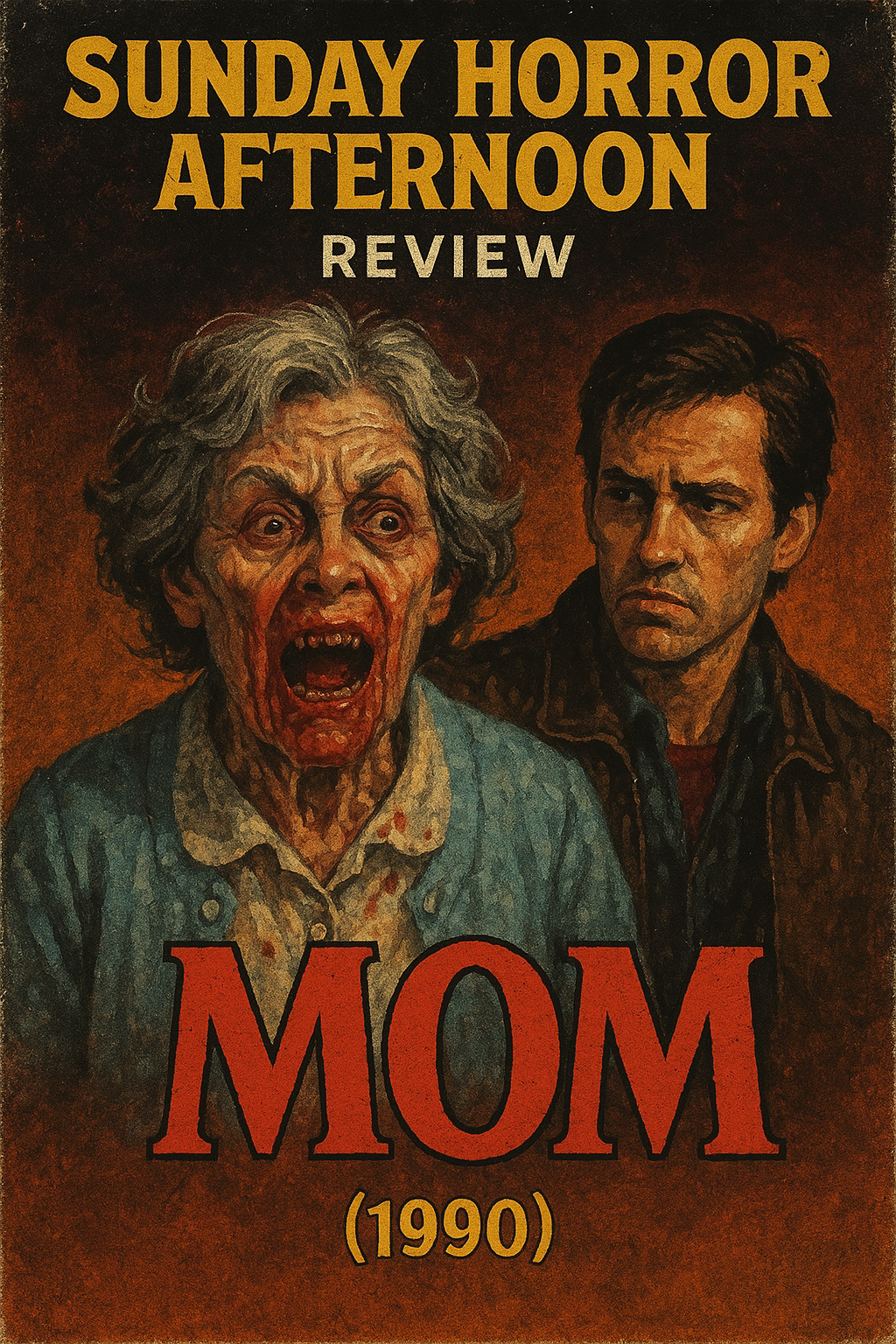
Sunday Horror Afternoon Review: Mom (1990)

Image
Few Films  capture the late-night video store aesthetic quite like Mom (1990), a lesser-known gem of early '90s horror that gleefully meanders between gruesome creature feature and tender, guilt-ridden family drama. Imagine a suburban nightmare penned by a gutter-poet philosopher—this is a movie where the mundane and the macabre coalesce into something unexpectedly poignant. At its core, Mom is a story about maternal love gone horribly wrong. Mark Thomas Miller plays Clay, a radio journalist whose life is upended when his elderly mother, Emily (Jeanne Bates), becomes the victim of a mysterious drifter/vampiric predator. What follows is a transformation—not just Emily’s horrifying physical metamorphosis, but the unsettling shift in their familial bond. The film thrives on contrasts. Emily’s sweet demeanor clashes with her newfound hunger for flesh, creating a queasy mix of tenderness and terror. Bates’ performance is nothing short of extraordinary—her portrayal of a ...

Liminal Jazz Café: Mulligan Meets Monk

Image
The café is half-empty, which is to say it is half-full of ghosts. A place that exists just outside of time, between two beats, the space where the note almost happens but never does. The sign flickers, the neon buzzing like a dying wasp. Inside, the smell of burnt coffee and old lacquer, of rain-soaked overcoats and newsprint dissolving into memory. Onstage, Gerry Mulligan and Thelonious Monk are playing something that never was. A baritone sax, warm as candlelight, curls through the air, seeking something just beyond reach. The piano answers in jagged steps, unpredictable and inevitable, each chord a question without an answer. The two of them speak in a language without words, a conversation that only exists in the moment it's heard. Life is like that, I think, sitting in the corner with a coffee gone cold. It doesn’t make sense, not in any way that matters. Patterns emerge and dissolve, meaning flickers like the sign outside. Monk stabs at the keys, Mulligan exhales a long, mou...

Trash Guru Review #2: Stuff Stephanie In The Incenerator

Image
*Stuff Stephanie in the Incinerator* (1989) is one of those obscure, low-budget oddities that feels like a fever dream of late-'80s direct-to-video horror. Released during the dying days of the slasher boom, it lacks the gore and sleaze of its more infamous contemporaries but compensates with a bizarre, almost theatrical structure that keeps you wondering if the filmmakers were in on the joke—or just had no idea what they were doing.   At its core, the film is about a wealthy couple, Jared and Stephanie, who are invited by their eccentric friend, Robert, to his mansion for a weekend of elaborate role-playing games that quickly take a sadistic turn. The movie sets up a series of betrayals, fake-outs, and power struggles, playing with the audience’s expectations in a way that almost feels like a lost *Tales from the Crypt* episode—except without the style, budget, or a cackling Cryptkeeper to reassure you that it's all meant to be fun.   Despite...

Review of CSI: Cyber

CSI: Cyber is the tech-savvy cousin of the long-running CSI franchise, trading blood splatter analysis for computer code and digital crime scenes. It’s the kind of show that doesn’t take itself too seriously, making it a surprisingly enjoyable binge for a lazy afternoon. Patricia Arquette leads the team as FBI Special Agent Avery Ryan, bringing her signature grounded intensity to the role. Alongside her, James Van Der Beek delivers a solid performance as Elijah Mundo, the muscle of the operation. The rest of the cast rounds out the ensemble well, each bringing their own quirks to the table. The series tackles cybercrime in ways that range from genuinely thought-provoking to hilariously over-the-top. Hackers, ransomware, and online predators are the usual suspects, though the technical realism can sometimes be sacrificed for dramatic flair (cue the classic "enhance" trope). What makes CSI: Cyber work is its fast-paced storytelling and the slick production value the fran...

A Masterpiece in Disguise: Why the 2024 SNL Movie Deserves a Second Look

The Saturday Night Live movie of 2024 might not have struck box office gold or achieved unanimous critical acclaim, but let me say it outright: this is a modern classic, a film destined for reevaluation in the years to come. Its poor reception? A mere footnote in the long history of misunderstood art. Yes, some, like Nathan Rabin at the AV Club , may dismiss it as another misguided attempt to stretch a beloved sketch format into feature length. But those criticisms miss the forest for the trees. This movie isn’t about punchlines or fleeting comedy—it’s about the unrelenting absurdity of life itself, wrapped in the anarchic, freewheeling ethos that SNL has embodied for decades. The film dares to be ambitious. Its fragmented narrative structure, often compared to Robert Altman’s Nashville or even the Coen Brothers at their most surreal, captures the disjointed, kaleidoscopic reality of our times. The script, filled with moments of biting satire and profound melancholy, feels less ...