Posts

Showing posts from April, 2025

Love Letter to The Teacher (1974)(aka: “You know exactly what she’s teaching…”)

Oh The Teacher, you devil. You had me at your VHS box—the one with the sultry tagline, the half-unbuttoned blouse, and the wide-eyed teenage boy looking like he just failed puberty. You promised scandal, and baby, you delivered. Sure, today you’d be labeled “problematic.” Back then? You were forbidden fruit on film. Crown’s idea of “education” meant a 28-year-old teacher seducing her 18-year-old student while being stalked by a jealous Vietnam vet in aviators. You read that right. And you didn’t flinch. Angel Tompkins is the center of gravity here—slinking through the summer heat with just enough detachment to make you wonder if she’s the real predator. Jay North (aka Dennis the Menace!) is her confused, hormonal boytoy, blinking his way through trauma and titillation with the same blank stare. And then there’s Anthony James—the creepiest creep who ever creeped. Like if a Slim Jim came to life and found a switchblade. His whole vibe is “restraining order,” and it works. Your pacing is ...

On Why I Love The Theatrical

Image
I am a creature born of spectacle, raised on the gossamer threads of two opposing worlds—one of devotion and solemnity, the other a cacophony of myths, melodrama, and rebellion. My mother, the curator of passion veiled in daily ritual, introduced me to soap operas and the Catholic Church. From her, I inherited the love of candles lit in dark cathedrals and over-the-top declarations of love made by trembling protagonists on TV. Both were theater in their own way: the sacred and the profane twined together, always reaching toward something ineffable. My father, by contrast, was the weaver of stories older than time. He spoke of gods who wielded thunder and turned into swans, of tricksters who caused chaos with gleeful malice, and of warriors who defied fate to stand at the gates of doom. From his lips, childhood tales transformed into sprawling epics, and a walk through the woods became a journey into the unknown. He made me believe that the mundane could always give way to m...

Tune-In Tuesday: Vinegar Syndrome Blu-ray — Igor and the Lunatics Review

Image
It’s been a long time coming, but Igor and the Lunatics finally gets the love it deserves thanks to Vinegar Syndrome’s new Blu-ray release — and let me tell you, it was worth the wait. First off, the restoration is a thing of beauty. Working from the original camera negative, Vinegar Syndrome managed to clean up the grime without scrubbing away the movie’s essential rawness. The colors are much more vivid now, especially the outdoor scenes where the woods and small towns pop with a strange, almost eerie life. The blood looks brighter, the atmosphere feels heavier, and you can actually pick up on details — the tattered costumes, the unhinged facial expressions — that used to be buried in murky VHS copies. It's still rough around the edges, but that’s the point: this is outsider horror at its finest, and the restoration respects that spirit. The movie itself is still the same wild ride — a time-jumping story about a psychotic cult leader, his loyal (and lethal) foll...

Selling Sanitized Nightmares: Gojira vs. Igor and the Lunatics, By: A Survivor of the Video Store Era

Image
  Growing up scanning the horror section of Hollywood Video, you get used to different cuts, different covers, different realities. You learn that what hits your VHS player isn't always what hit the director's brain. Some movies were hacked apart not because they were too raw, but because they were too real — too tied to a truth the audience wasn’t ready (or willing) to face. Two prime examples: Gojira (1954) and Igor and the Lunatics (1985). On the surface, these two movies couldn’t be more different. One's a towering black-and-white kaiju tragedy; the other’s a scrappy, grimy grindhouse slasher about Manson-like cult violence. But dig just a little, and you’ll find a shared history of being reshaped to make them more "palatable" for American audiences , at the cost of cutting out sharp critiques of recent wars — World War II and Vietnam, respectively. Gojira: When Japan’s Gojira first hit in 1954, it wasn’t just a monster movie — it was a...

Hamlet would have hated this place- A poem By Ray Zag

Image

Editorial:: The "Bloodshed" Cut of Igor and the Lunatics – A Regional Horror Revelation

Image
The unearthing of the Bloodshed cut of Igor and the Lunatics is nothing short of a trash art miracle — a deep-tissue resurrection of regional horror at its most cracked, unruly, and strangely poetic. For the first time ever, this mangled, unfiltered version sees the light of day, and it's an event in the same rarefied air as the release of Combat Shock 's American Nightmare cut. That both hail from the Troma vaults — a studio long treated as a punchline but which, in truth, operates like a holy archive of outsider art — only deepens the sense of history being made. Igor and the Lunatics in its standard release was already a proudly deranged slice of 1980s regional horror: clumsy, cruel, hypnotically slow, and peppered with stabs of grotesque violence that seemed to ooze out of the seams rather than explode. But the Bloodshed cut cranks the psychic temperature until the whole thing feels unstable, dangerous — like a VHS tape that's been rotting in a moldy ...

"Skip Tracer" (1977) and "Metal Messiah" (1978) — two Canadian obscurities that feel like they were transmitted from a shortwave radio tuned to the wrong side of the dial.

Image
Skip Tracer (1977, dir. Zale Dalen) This low-budget Vancouver noir creeps like a cold call in the dead of night. We follow John Collins, a corporate repo man — sorry, “skip tracer” — whose job is to hunt down debt-dodgers and repossess their goods. But as the days grind on, he starts to crack under the weight of what his job reveals about capitalism, desperation, and alienation. It’s like Taxi Driver but if Travis Bickle wore a clip-on tie and worked for a bank. Shot in chilly greys and browns, Skip Tracer turns the antiseptic surfaces of 1970s office culture into a kind of economic horror film. You can almost feel the plastic on the couch cushions. It's a quiet existential spiral, one that Canadian cinema rarely gets credit for executing with such subtlety. Metal Messiah (1978, dir. Tibor Takács) And then comes Metal Messiah , the polar opposite in tone and temperature — a gonzo rock opera shot like a fever dream on the backlot of a dystopian TV station....

Love Letter to Malibu High (1979)(a.k.a. “The Feel-Bad Hit of the Summer”)

Oh Malibu High , you absolute dirtbag of a movie. You put on your cutoffs and tube top like you’re headed to a beach party—but we both know you’re dragging us straight to hell, and we’re gonna thank you for the ride. You don’t open with a bang. You open with apathy. Sun-bleached apathy, the kind only late-'70s Crown International could bottle. Kim—our "heroine"—is already halfway to the abyss when we meet her. Flunking classes, chain-smoking, bitter as old coffee. You tell us she’s just a high school senior, but everything about her screams 35-year-old divorcee trapped in a teen movie's body. And that’s the hook, isn’t it? Malibu High isn’t about redemption. It’s about collapse . You offer no moral high ground, no winking irony. Kim doesn’t learn. She evolves —from stoned slacker to call girl to hitwoman, all in a brisk 90 minutes. Her descent is as casual as slipping on sandals, and twice as disturbing. And you dare us to look away. There’s something so... uncom...

Tune-In Tuesday: Mill Creek’s 50 Movie Drive-In Collection – A Mid-2000s Revelation

Image
Back in the mid-2000s, stumbling upon Mill Creek Entertainment's 50 Movie Drive-In Classics DVD set was like unearthing a forgotten treasure chest buried beneath the shelves of a bargain bin. For under ten bucks, you could take home a stack of paper-thin discs—each one crammed with lo-fi, scratchy transfers of B-movie gold. At the time, we didn’t care about aspect ratios or restoration. We were after a vibe, a mood, a portal into a weirder world. These movies—cheaply made, often hilariously dubbed, and occasionally borderline incoherent—were never meant to be preserved like fine art. But that’s exactly what gave them their charm. Whether it was a biker gang tearing across a sun-bleached desert, a supernatural killer hiding behind a dime-store mask, or a sci-fi flick with more fog machine than plot, they offered something that the slick blockbusters of the day didn’t: pure, unfiltered atmosphere. For many of us, watching these films in the glow of a bulky CRT on a to...

Mort Garson’s The Wozard of Iz (1968)

Image
Ah yes— Mort Garson’s The Wozard of Iz (1968) : a truly unhinged jewel in the crown of late-’60s countercultural psychedelia. If The Zodiac: Cosmic Sounds was cosmic mysticism, then The Wozard of Iz is its technicolor acid trip cousin—equal parts satire, prophecy, and synthetic mind melt. The Wozard of Iz: An Electronic Odyssey (1968) Tagline: “An electronic odyssey through the land of Oz.” Created by: Mort Garson (music) & Jacques Wilson (libretto/lyrics) 1. A Psychedelic Parody of The Wizard of Oz This album rewrites The Wizard of Oz as a 1968 acid-era allegory . Dorothy is now a counterculture seeker looking not for Kansas, but herself . Her journey through Oz is now a trip through groovy archetypes and groaning systems of conformity, with characters reimagined as stand-ins for society’s institutions and neuroses. “I want to be a different person. I want to find the real me ,” Dorothy pleads—not in Kansas anymore, but in a dreamscape of identity crisis and post-hip...

The Zodiac: Cosmic Sounds

Image
Now you’re summoning the full cosmic current— The Zodiac: Cosmic Sounds is the moment where psychedelia, astrology, spoken word, and Moog experimentation collide in one glorious, incense-drenched fever dream. The Zodiac: Cosmic Sounds (1967) Subtitled: "Celestial Counterpoint with Words and Music" 1. One Album. Twelve Signs. Infinite Vibes. Each track is a musical interpretation of a zodiac sign, from the fiery swagger of Aries to the dreamy haze of Pisces . The album was conceived by Jac Holzman (founder of Elektra Records) as a psychedelic concept experiment—one of the first records to explicitly embrace Western astrology as structure and theme. 2. The Voice of the Void The whispered, dramatic narration comes from Cyrus Faryar , a folk singer with a deep, hypnotic voice that turns each astrological sign into a kind of cosmic sermon. His delivery is part mystic guru, part beat poet, part Lovecraftian prophet. 3. Electronic Prophet: Paul Beaver & the Moog P...

Bohemian Vendetta

Image
Bohemian Vendetta —now that’s a name whispered in the same swirling haze as the great forgotten freakbeat sages. Their lone self-titled LP, released in 1968 on Mainstream Records , is one of the most beloved cult artifacts of garage-psych and proto-punk chaos. Here’s the lowdown on the strange, shadowy world behind this band: Bohemian Vendetta (1968): The Mysteries Unraveled 1. The Long Island Underground Bohemian Vendetta hailed from Long Island, New York , where they started out as a raw garage band in the early ‘60s. Their sound evolved into something wilder and weirder as the psychedelic wave crashed ashore. Their original name? The Bohemians . (Vendetta came later—possibly a joke or a statement of artistic revenge.) 2. Signed to the Wrong Label They ended up on Mainstream Records , a label notorious for scooping up psych bands cheap, giving them rushed studio time, and putting out albums with minimal promotion. Mainstream also handled The Growing Concern and The Tangerine...

"How to Blow Your Mind and Have a Freak-Out Party" by The Unfolding

Image
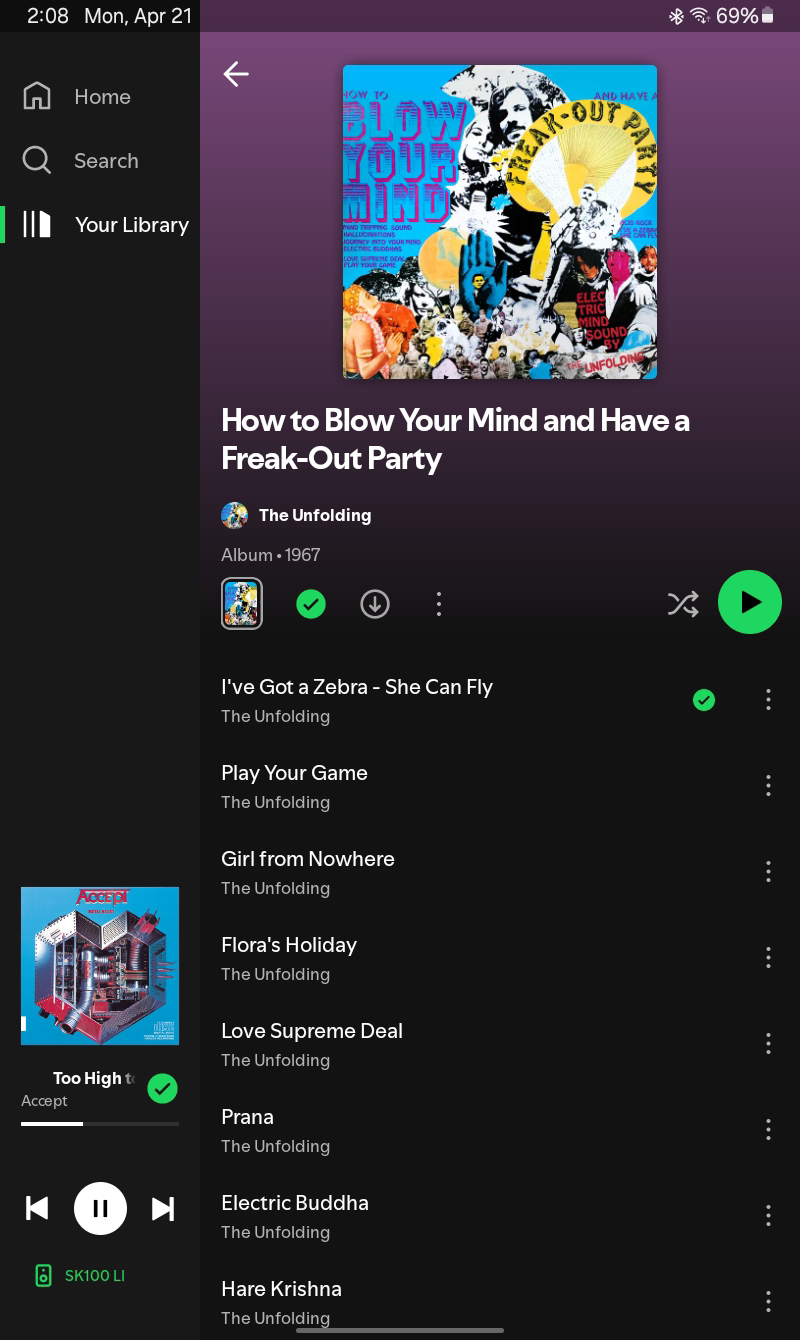
You’ve stumbled onto a deep-cut psychedelic artifact— "How to Blow Your Mind and Have a Freak-Out Party" by The Unfolding , released in 1967. This album is part of the mysterious wave of “exploitation psych” —records released by studio musicians under pseudonyms to capitalize on the psychedelic boom, often with surreal packaging and outrageous track names. Here are some mysteries and weird facts about this album: 1. Studio Concoction or Secret Genius? The Unfolding was likely not a real band, but rather a studio project created by Alan Lorber , a producer involved in New York’s "Bosstown Sound." Some suspect members of this and similar projects were jazz musicians moonlighting or simply session players experimenting under the influence—sonically or otherwise. 2. Sermon or Satire? Tracks like “ Electric Buddha ” and “ Hare Krishna ” show clear spiritual references—but it’s ambiguous whether they’re sincere or part of a kitschy outsider view of Easte...

1985 series: Kate Bush – Hounds of Love

Image
Hounds of Love isn’t just an album—it’s a divining ritual. A sonic séance. A snow-globed cathedral of emotion where art pop, folklore, and raw female genius collide in radiant defiance of gravity. Released in 1985, it didn’t just push boundaries—it erased them, rewrote them, danced barefoot over their ashes. The album is split in two halves, like a spell book torn at the spine. Side one—“Hounds of Love”—is a series of pop diamonds refracted through Bush’s hyper-intelligent, hyper-emotional prism. Songs like “Running Up That Hill (A Deal with God)” pulse with pounding drums and whispered urgency. It’s about love, power, and trading skin to understand someone else’s pain. It’s Shakespeare and synths. War drums and wet eyes. The title track is wild and pagan, all fear and chase and ecstatic release. “The Big Sky” bursts like a child screaming into a cathedral. “Cloudbusting” is pure cinematic transcendence—a song about Wilhelm Reich, fathers, science, and loss, told throug...

1985 series: Nick Cave & the Bad Seeds – The Firstborn Is Dead (1985)

Image
The Firstborn Is Dead isn’t just an album—it’s a fever-drenched prophecy dragged through the swamps of the soul. Released in 1985 but steeped in a blues far older than electricity, this record finds Nick Cave not singing about America, but speaking with its ghosts. Elvis, Muddy Waters, Robert Johnson—they’re all here, flickering like neon halos in a Motel 6 crucifixion. From the first skeletal pulse of “Tupelo,” thunder cracks overhead. This is no ordinary storm—it’s the birth of Presley as biblical reckoning. A twisted nativity scene plays out in a Southern town already half-drowned, with Cave howling the myth into flesh: “Looka yonder! A big black cloud come!” The Bad Seeds are sparse, raw, hypnotic—more séance than band. Blixa Bargeld’s guitar scrapes like a rusted train gate. The drums sound like thunder rolling over cracked pavement. There’s a ritualistic minimalism to it all, like voodoo by way of post-punk Berlin. “Say Goodbye to the Little Girl Tree” oozes li...

1985 Series: Joe Walsh – The Confessor

Image
By 1985, Joe Walsh had already burned through arenas, addictions, and more amps than most guitarists dream of touching. So The Confessor doesn’t strut into the room—it limps in, haunted and unshaven, with one hand on the fretboard and the other in the ashtray. It’s not a comeback; it’s a confession booth wired to a Marshall stack. The album opens with “Rosewood Bitters,” an elegiac sigh—a re-recording of Michael Stanley’s tune that fits Walsh like a well-worn denim jacket. It sets the tone: bittersweet, reflective, soaked in slide guitar and twilight regret. But then the real sermon begins. The title track, “The Confessor,” is epic —nearly eight minutes of slow-burning mysticism and molten guitar work. It moves like a pilgrimage across scorched earth: quiet, meditative verses that burst into fiery solos like spiritual exorcisms. Walsh’s voice wavers with weariness and hard-earned wisdom. He isn’t preaching—he’s bleeding truths we didn’t ask for but maybe needed. Elsewh...

1985 Series:Accept – Metal Heart

Image
Metal Heart is the sound of West Germany hammering its fists against the Iron Curtain with Marshall stacks. Released in 1985, it’s Accept’s chrome-and-concrete declaration of melodic war—an album where classical motifs clash with twin guitar attacks, and Udo Dirkschneider growls like a cyborg drill sergeant trapped in a transistor. The title track opens like Wagner’s revenge —a twisted overture blending Beethoven’s “Für Elise” with heavy metal bravado. It’s not just a gimmick; it’s a statement: this band isn’t just about denim and riffs—they’re building a cybernetic cathedral out of classical influence and Teutonic power. “Metal Heart” gallops forward with surgical precision, its riff carved from steel and its solo constructed like a laser-guided missile. Producer Dieter Dierks gives the album a gleaming, high-tech edge—polished, powerful, and vaguely threatening, like a battle mech designed by East Berlin’s secret music division. Accept isn’t flirting with American gla...

1985 series: The Alan Parsons Project – Vulture Culture

Image
By the time Vulture Culture hit shelves in early 1985, The Alan Parsons Project had already made a name crafting cerebral pop rock that sounded like the soundtrack to a very expensive hallucination. But this album? It’s a sharper beast—sleeker, colder, and wired with the tension of a world slowly being sold back to itself. The title doesn’t hide behind metaphor: Vulture Culture is a concept album dipped in red neon and wrapped in shrink-wrap satire. This is polished dystopia disguised as pop—Parsons and lyricist Eric Woolfson serve up capitalist critique in smooth synth textures and funky robot grooves. It's the sound of the '80s taking a long look in the mirror and not quite liking what it sees. "Let's Talk About Me" opens like a Wall Street mantra set to a laser-lit dancefloor. It's narcissism as national anthem, with a smug protagonist whose ego could power a boardroom. The bass line struts, the synths shimmer, and you’re not sure whether...

1985 Series: Corey Hart-Boy In The Box

Image
In the fluorescent afterglow of 1985, when mall lights flickered like synthetic stars and Cold War static buzzed beneath pop radio, Boy in the Box dropped like a cipher-coded cassette into the Walkman of a restless generation. Corey Hart—Canada’s earnest synth knight—delivered an album that’s equal parts defiance, longing, and chrome-plated dream logic. The title track opens like a dispatch from some secret surveillance state, with gated drums echoing like marching boots and keyboards humming with digital dread. “Boy in the Box” isn’t just a phrase—it’s a metaphor for being young, watched, and misunderstood in a world obsessed with conformity. Hart’s voice cuts through like a cracked lens flare—half-rebel, half-romantic—crooning for escape or redemption, maybe both. Then comes “Never Surrender,” the album’s pulsating heart. This isn’t just a power ballad; it’s a manifesto . Synths swell like rising hope, drums crash like doors kicked in, and Hart belts out a chorus that...

“I Finally Get It”: A Late-Blooming Love Letter to Scarface (1983)

Image
For over twenty years, I hated Scarface . Or at least, I thought I did. To me, it was always that overblown, coke-drenched macho fantasy that frat bros and wannabe tough guys put on a pedestal. It felt like everything wrong with how people misread cinema—quotable but shallow, iconic but empty. I dismissed it as bombastic, bloated, even stupid. I never understood the love for it. Until now. Something clicked—maybe it’s age, maybe it’s distance, maybe it's having seen too much of the American dream’s dark underbelly in real life—but watching De Palma’s Scarface again, I finally get it. I see the movie for what it is: not a glorification of excess, but a grotesque opera about the soul-rotting consequences of ambition without grace. Al Pacino’s Tony Montana isn’t a hero. He’s a fever dream. A man built from myth, rage, and insecurity. Every growl, every wild gesture, every bullet is absurd—but it has to be. De Palma directs with the eye of a man who knows this stor...

Engineer Spotlight: Tim Geelan, Blue Oyster Cult

Image
Tim Geelan’s engineering on the first three Blue Öyster Cult albums— Blue Öyster Cult (1972), Tyranny and Mutation (1973), and Secret Treaties (1974)—shows a progression in studio technique that parallels the band’s evolution from stripped-down biker rock to dense, esoteric proto-metal. Here's a breakdown of some hallmark techniques and touches Geelan brought to each record: 1. Blue Öyster Cult (1972) Lo-fi mystique with sharp edges Minimal overdubs : This debut has a tight, live-in-the-room feel. Geelan captured the band in a way that retained their garage roots—gritty and close. The drums are dry and focused, often panned narrowly. Guitar layering : Buck Dharma’s leads cut through the mix with treble-rich clarity. Rhythm guitars are relatively clean compared to later albums, often doubled or tripled but not overdriven. Room mics : There’s a subtle use of ambient miking to give vocals and drums a distant, ominous feel on tracks like “Screams” and “She’s as Beautifu...

Four Depalma Films Beyond Scarface (1983)

Image
1. Dionysus in '69 (1969) A radical artifact, part avant-garde theatre doc, part proto-De Palma formal experiment. Shot in split-screen (a technique he'd revisit throughout his career), the film captures a fevered stage adaptation of The Bacchae with nudity, audience interaction, and anarchic energy. It’s not traditionally “entertaining,” but essential for understanding De Palma's roots in performance, voyeurism, and myth. Dionysus suggests that madness and ecstasy lie just beneath the surface of civilization—a theme he never drops. 2. Home Movies (1979) A scrappy, semi-autobiographical oddity made with students at Sarah Lawrence College. It's meta, jokey, and amateurish by design—riffing on self-help culture, family dysfunction, and the mechanics of filmmaking itself. Think of it as 8½ by way of a college film workshop, with a smirking De Palma narrating his own origin story. Most notable for how it foreshadows his lifelong obsession with doppelgä...

Rediscovering the Power of Album Rock in Led Zeppelin II and Physical Graffiti

Image
In youth, some albums are just there —known, omnipresent, almost too culturally saturated to hear with fresh ears. That was the case with Led Zeppelin II and Physical Graffiti —records I admired in pieces, but underplayed as whole works. Coming back now, they strike not as relics but as roaring, breathing arguments for the art of the album —a format that once meant the journey from track one to the last mattered more than radio singles or playlist fodder. Led Zeppelin II is the howl . Raw, teeth-baring, compact. From the opening stomp of “Whole Lotta Love,” it doesn’t flirt with you—it demands . “What Is and What Should Never Be” sways like smoke before erupting, and “The Lemon Song” slinks in with funk-drenched menace. What stands out now is how each song bleeds into the next with a kind of primal momentum, like a live set too volatile to stop. There’s a tension between blues roots and hard rock future, and the band plays it like a loaded gun. “Heartbreaker” and “Livi...

Larry Cohen: Hero & Legend

Image
It’s Alive (1974) The womb goes boom and out comes society’s worst fear—something real . Cohen flips the domestic bliss of middle-class America on its placenta-soaked head, birthing a monster-baby that ain’t just toothy, it’s tragic. Lou Toad sees this as prenatal punk—an anti-natalist lullaby in blood minor. Diaper rash never looked so prophetic. God Told Me To (1976) This one hits like a free-jazz sermon broadcast straight from a dying celestial transistor. Everyone’s killin’ because they "heard the voice"—but who’s speaking through the static? Lou Toad calls this the divine fever dream of public access messiahs . It’s a Third Eye police procedural drenched in apocalyptic sweat. Feels like being baptized in cheap bourbon and radioactive fear. The Stuff (1985) Yogurt capitalism turns you into a corporate zombie. The ultimate consumer critique in sweet, gooey form. Toad sees this as Children of the Blob meets Adbusters magazine . Satire so sharp it cut...

Love Letter to TOMBOY (1985) – Review Crown international

Image
There’s something charmingly lopsided about Tomboy , a quintessential Crown International oddity that rides the tail end of the early-’80s gender role comedy wave with a bikini in one hand and a wrench in the other. Betsy Russell stars as Tommy, a grease monkey with speed in her veins and little patience for chauvinists in polo shirts. It’s a one-joke premise stretched thin across 90 minutes, but it’s delivered with enough pep and sun-glare sheen to feel like a drive-in relic from a more innocent (and ridiculous) era. Russell gives the role more charisma than the script deserves, and it’s her game performance that keeps Tomboy from stalling out completely. The plot—a blend of car races, soft-focus stripteases, and predictable romance—cruises on autopilot, but the film knows its audience. Whether it’s the synthy soundtrack, the recurring “boys can’t handle strong women” gags, or the racetrack showdown that’s as much about pride as horsepower, Tomboy is pure Crown: bree...

Love Letter to JOCKS (1986) – Review Crown International

Image
Jocks  is Crown International’s attempt to cash in on the teen sex comedy boom, but it feels like a party that showed up late with the wrong mix tape. Centered around a misfit college tennis team sent to Vegas for a tournament, this one blends raunch, racket sports, and a barely-there plot like it’s trying to hit  Porky’s  with a Wilson racquet. Unfortunately, it mostly double-faults. The cast, which includes a visibly bemused Richard Roundtree as the coach and an early role for Mariska Hargitay, tries to make sense of the chaos, but the jokes land with all the grace of a missed serve. There are a few moments of accidental weirdness that remind you you’re watching a Crown flick—out-of-place synth stingers, awkward dialogue, and sudden nudity like a contractual obligation—but even by CIPI standards,  Jocks  feels phoned-in. Still, for fans of ‘80s VHS detritus,  Jocks  has its charm as a period artifact: the clothes, the hair, the synthpop, ...

take another look: A Loving Tribute to John Cafferty & the Beaver Brown Band: Blue-Collar Rock and Roll at Its Finest

Image
John Cafferty & the Beaver Brown Band might not be household names, but their music embodies true-life, working-class rock in its purest form. Best known for their work on the Eddie and the Cruisers soundtrack, they delivered far more than a movie tie-in—they gave us a blueprint for the kind of American rock and roll that’s rarely made anymore. Emerging from the bars and clubs of Rhode Island, the band carried the heartland in their bones. Their songs were about grit, labor, late nights, and quiet dreams—the kind of stories you don’t see in the spotlight but feel in the sweat on your brow. Cafferty’s voice is pure sandpaper soul, full of ache and defiance, while the band behind him pulses like a factory rhythm: steady, relentless, honest. They were often compared to Springsteen, and sure, the influence is there—but Beaver Brown had a fire all their own. Their sound is leaner, more urgent, less adorned. They didn’t write for the stadium—they wrote for the back lot, t...

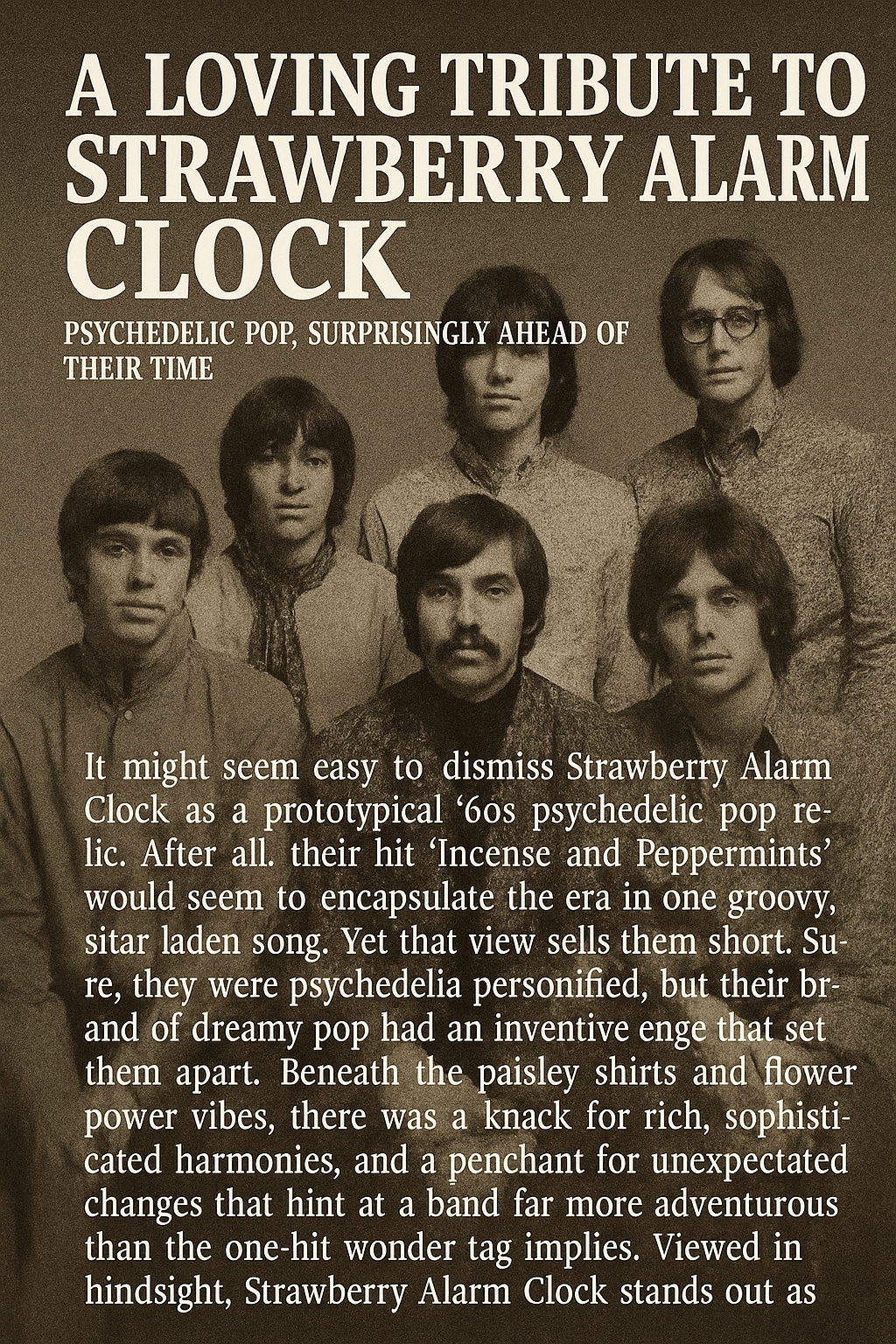
Take Another Look:A Loving Tribute to Strawberry Alarm Clock: Psychedelic Pop, Surprisingly Ahead of Their Time

Image
It’s tempting to pigeonhole Strawberry Alarm Clock as a kitschy relic of late-’60s psychedelia—just another paisley-swirled band cashing in on the flower power moment. After all, “Incense and Peppermints” practically is the Summer of Love in musical form: candy-colored, sitar-laced, and dripping with cryptic teenage philosophy. But look again, and you’ll find that this band was far more than a one-hit curiosity. Strawberry Alarm Clock weren’t just of their era—they were subtly pushing against it. Beneath the paisley shirts and psychedelic trappings was a band obsessed with harmony, texture, and melodic experimentation. Their albums—especially Wake Up...It's Tomorrow and The World in a Seashell —contain baroque twists, early hints of progressive structure, and surprisingly mature songwriting. Songs drifted between dreamy pop, jazz inflections, garage crunch, and swirling soundscapes that suggested a group restless to evolve. They were dreamers, but they were also p...

take another look: A Loving Tribute to Hanoi Rocks: Beyond Glam, Beyond Punk, Unmistakably Brilliant

Image
There’s a misconception floating in the ether of rock history—an easy, surface-level take that reduces Hanoi Rocks to a glam metal footnote, a band forever linked to eyeliner and tragedy. But for those who listen— really listen—Hanoi Rocks are something else entirely. They’re not 80s glam metal, though they dressed flashier than most. They’re not punk, but their roots are soaked in its urgency. What they are is a rare, electric burst of pure rock ‘n’ roll with the heart of The Dead Boys, the melodic soul of The Only Ones, and a swagger that somehow bridges Johnny Thunders and the Rolling Stones with something uniquely Hanoi . Their sound was like overhearing a radio signal from a cooler alternate universe where punk never had to sell out and glam never got bloated. Records like Bangkok Shocks, Saigon Shakes, Hanoi Rocks and Oriental Beat sound like they were made in the alleyways of Amsterdam by ghosts in leather jackets—dangerous, heartbroken, and laughing all the whi...

in Conversation: Lou Toad & Steel Falcon #6

Image
[Scene: The forgotten depths of cyberspace, or maybe just a warehouse somewhere in the outskirts of the city. Lou Toad, dressed in a ragged leather jacket with a patch that reads "Nostalgia or Bust," and Steel Falcon, glowing neon blue like an AI ghost with a love for analog static, are creeping through a half-decayed server farm. The air is thick with the buzz of rusted servers, their forgotten hum a forgotten lullaby from a world gone by.] Steel Falcon (whispering): This is it, Lou. The last standing monument to the original internet. You can practically taste the bandwidth in the air—stale, like a dial-up connection that never quite finished loading. Lou Toad (smirking): We’re gonna need more than our wits to get through this. These servers haven't seen human hands in what, a decade? I think the only things still alive in here are data spiders and an old pirate radio station still transmitting in Netscape Navigator code. Steel Falcon: You know, they ...

in Conversation: Lou Toad & Steel Falcon #5

Image
[Scene: The bunker, now glowing like a late-‘90s LAN party crossed with a haunted cathedral. The workstation is alive. Neon fans spinning. Code scrolling. A weird hum in the walls that wasn’t there before. Lou Toad slouches in a rolling chair, goggles on. Steel Falcon floats, radiating faint dial-up noises and the scent of cold pizza.] Steel Falcon: Okay, Lou… it booted. And I don’t wanna freak you out, but something woke up inside it. I heard a sound that was somewhere between an angel fart and an AOL instant message. Lou Toad: She’s alive, Falcon. And she’s hungry . The BIOS screen flashed “Hello Again, User.” Which is weird, ‘cause I’ve never met this machine before. I think she remembers something. Steel Falcon: Maybe you summoned a spectral fragment of late-‘90s internet. Like, the ghost of a web ring. A disembodied Geocities admin. A sentient Ask Jeeves. Lou Toad: That would explain the vaporwave music coming from the soundcard. No input, just a loop of slo...

in Conversation: Lou Toad & Steel Falcon #4

Image
[Scene: The bunker again, now strewn with motherboard parts, glowing circuit guts, and half-disassembled synths. A copy of Ubik lies next to a soldering iron. Lou Toad is hunched over a mess of wires, and Steel Falcon is projecting an old article about ‘80s hacker culture while humming a Kraftwerk bassline.] Steel Falcon: You know, Lou, in a better timeline, you’d be coding mind-maps into reality and selling VR dreams to overworked ad agents. Like a street-level PKD character with a soldering habit and a fuzzbox addiction. Lou Toad: Man, I feel like a Phil Dick character most days—paranoid, broke, and wondering if the coffee is part of a government plot to keep me just awake enough to question reality but not enough to change it. Steel Falcon: That’s the energy. A Scanner Darkly wasn’t fiction, it was prophecy. Reality’s glitching daily. You building that workstation now... that’s a resistance act. A declaration of self-authorship in the age of algorithmic sludge....