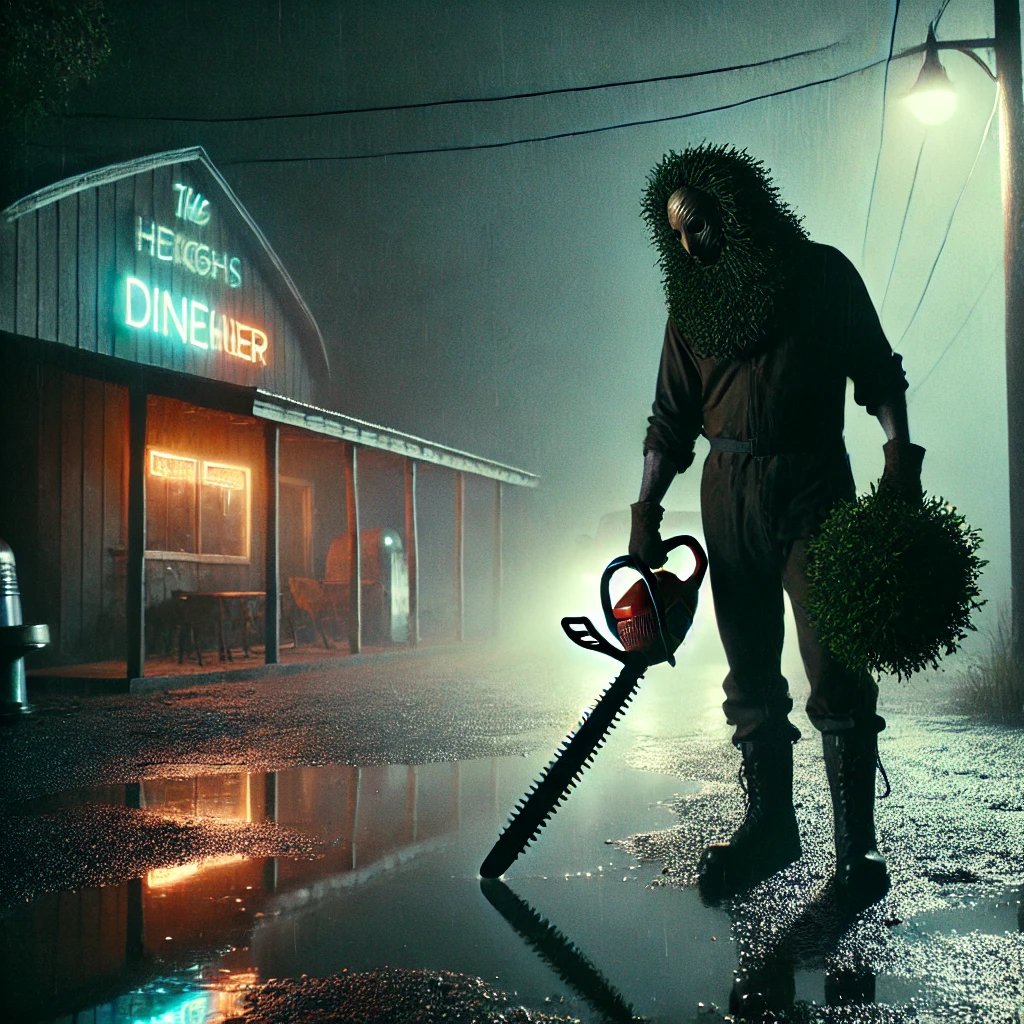
There’s a certain grit to The Night Brings Charlie , a low-budget slash through the fogged-up window of late-’80s slasher cinema. You don’t watch it; you stumble into it, like a roadside dive at last call, half-expecting regret, half-hoping for salvation. The film itself is the cinematic equivalent of a rusted blade—coarse, unapologetic, and more effective than it has any right to be. Directed by Tom Logan, this is no highbrow deconstruction of the genre, no satirical smirk. It’s a grimy piece of work, a slash-and-dash pulp novel in celluloid form, as honest in its ambition as it is shameless in its execution. Our killer, Charlie Puckett, is an enigmatic silhouette. A landscaper turned murderer, wielding a tree-trimming mask and hedge clippers with a kind of perverse solemnity. He is less man, more myth—a shadow painted in broad strokes, purposefully vague yet somehow indelible. Like Tosches’ portrait of Dean Martin as a ghost haunting his own myth, Charlie looms larger ...
Saturday morning, bowl of sugary cereal in hand, flipping channels between cartoons and live-action weirdness, because that was peak ‘90s TV. Somewhere between Doug and Are You Afraid of the Dark?, Nickelodeon tossed out Welcome Freshmen, and a few years later, the world gave us Student Bodies. Two shows about high school, but completely different flavors—one like a slapstick gum commercial, the other like a comic book that accidentally got cool. Welcome Freshmen (1991-1993): Nickelodeon’s Half-Sketch, Half-Sitcom Brainchild First season? A fever dream. Skits, absurd teachers, surreal school nonsense—almost like You Can’t Do That on Television had a cousin who got detention for being too weird. Then suddenly, someone in a suit said, “Let’s make this a real sitcom,” and—bam!—we had a slightly goofier, low-budget Saved by the Bell. It was messy, it was awkward, but wasn’t that what being a freshman felt like? The humor was that weird, random early-'90s Nickelodeon energy where everyt...
Ah, breaking the cycle. The phrase itself is deceptively simple, isn’t it? Two words, innocuous on their own, but together they sound like a hammer on an anvil, like a declaration of war against...what exactly? The ghosts of family dinners past, the chain-smoking uncle with his cryptic wisdom, the matriarch who ruled her home with an iron will and a ladle? The sins of the father, as they say, but not just his—also the grudges of the mother, the envy of the cousin, the apathy of the sibling. And somehow, these legacies, tangled as fishing nets, fall into your lap. It starts small. You’re 8 years old, standing in the living room as your parents argue for the fifth time that week. You think, "When I grow up, I’ll never shout like that." Fast forward, and there you are, 30 years old, voice hoarse, trying to explain why you’re late for dinner again. The cycle, it seems, has you in its grip. It’s not some grand Shakespearean curse, but rather the quiet, relentless habits that seep ...

 BULLIES:

Comments
Post a Comment